Sunday, May 24, 2020

The Ascension of the Lord

John S. Copley, Ascension, 1775 (Image: Wikipedia).
From Acts 1:9-11:
When Jesus had said this, the apostles saw him lifted up, and a cloud caught him away from their sight. And as they strained their eyes towards heaven, to watch his journey, all at once two men in white garments were standing at their side. Men of Galilee, they said, why do you stand here looking heavenwards? He who has been taken from you into heaven, this same Jesus, will come back in the same fashion, just as you have watched him going into heaven.

Friday, May 08, 2020

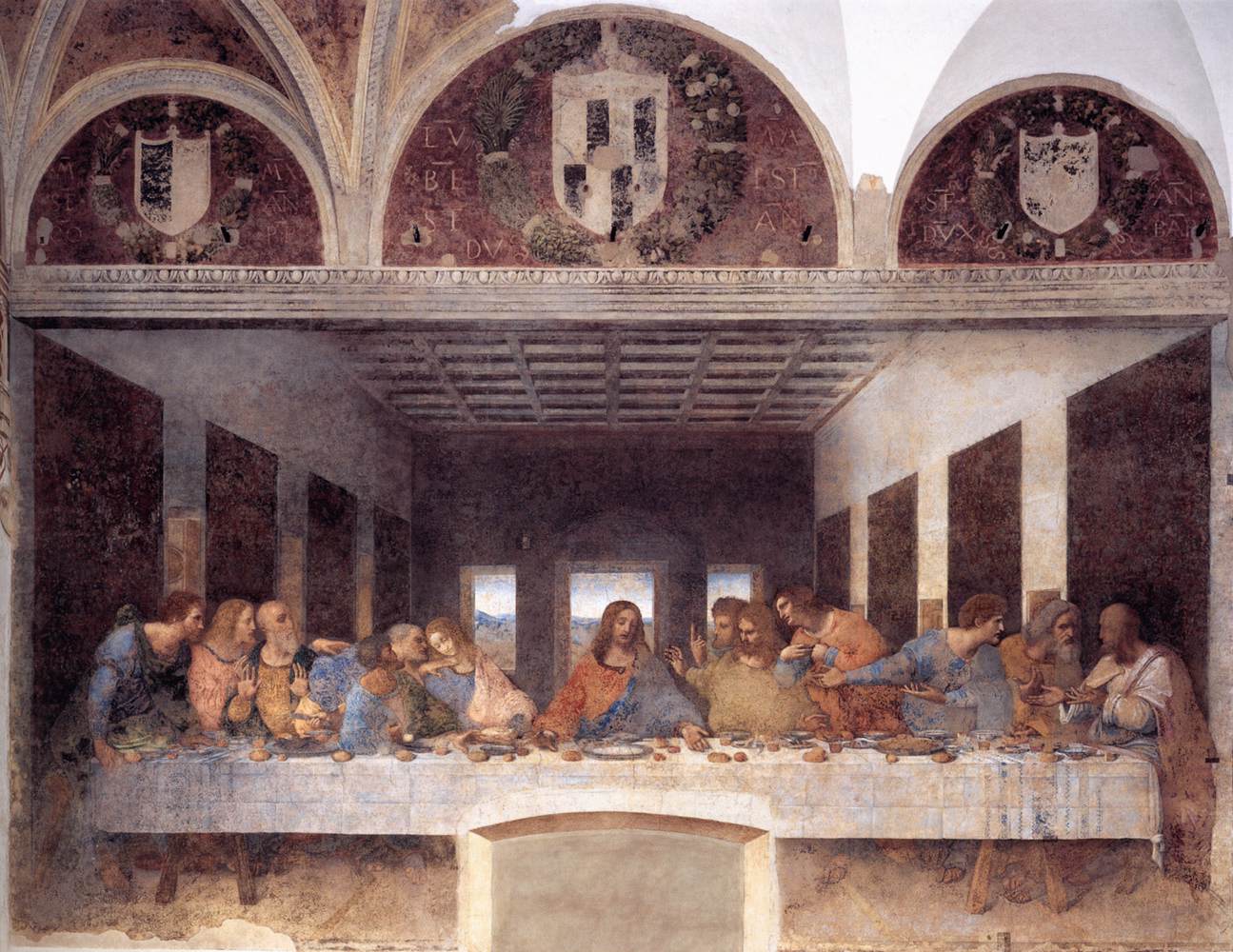
The Last Supper


Leonardo da Vinci, The Last Supper, 1497-1498 (from Web Gallery of Art)

Leonardo da Vinci's masterpiece, The Last Supper, is on the wall in the refectory (dining room) of Santa Maria delle Grazie in Milan.  According to the Web Gallery of Art,
The real dining room appears to be continued in the perspectivally painted one, but on a higher level: the prior's table is upstaged by that of Christ and the apostles above. Christ and the apostles seem to have taken their place in the monk's dining hall in Milan, as it were. The emphatic gestures of the larger-than-life-size, heroic figures would have contrasted once with the quiet, controlled meal of the monks. A sublime, sacred drama overshadowed the worldly meal and focused the brothers' attention religious meditation. Leonardo depicted a specific moment of the Last Supper: Christ has just announced that he will be betrayed by one of the disciples, and the community of apostles reacts with agitation and questioning.
That is a coincidence: my mother's parents had a copy of this in their kitchen, above their kitchen table. 

Sunday, April 26, 2020

Sea at Ogunquit

Edward Hopper, Sea at Ogunquit, 1914 (from https://whitney.org/collection/works/6077)

To celebrate Maine's bicentennial (Maine's secession from Massachusetts was part of the Missouri Compromise), the USPS has issued a stamp that features Edward Hopper's 1914 painting Sea at Ogunquit.  Hopper expressed his views on art in the following Statement ("Statements by Four Artists," Reality, Volume 1, Number 1, Spring 1953, via Wikipedia):
Great art is the outward expression of an inner life in the artist, and this inner life will result in his personal vision of the world. No amount of skillful invention can replace the essential element of imagination. One of the weaknesses of much abstract painting is the attempt to substitute the inventions of the human intellect for a private imaginative conception.
The inner life of a human being is a vast and varied realm and does not concern itself alone with stimulating arrangements of color, form and design.
The term life used in art is something not to be held in contempt, for it implies all of existence and the province of art is to react to it and not to shun it.
Painting will have to deal more fully and less obliquely with life and nature's phenomena before it can again become great.

The Good Shepherd


“The Good Shepherd ,” Medieval Art, accessed April 26, 2020, http://projects.leadr.msu.edu/medievalart/items/show/15.
Today's Gospel is from the tenth chapter of the Gospel of John (10:11-16):
I am the good shepherd. The good shepherd lays down his life for his sheep.
The image here is a fifth-century mosaic in a mausoleum in Ravenna, Italy.  Note that the sheep are all looking at Jesus, the shepherd, who is sitting in a pasture but wearing royal robes.  The shepherd is also a king.

Sunday, April 19, 2020

Doubting Thomas

Caravaggio, The Incredulity of Saint Thomas, 1602 (Wikipedia)
Today is Divine Mercy Sunday, and the Gospel is from Chapter 20 of the Gospel of John.  The painting here shows the moment at which Jesus confronts Thomas:
Jesus said to Thomas, "Let me have thy finger; see, here are my hands. Let me have thy hand; put it into my side. Cease thy doubting, and believe." Thomas answered, "Thou art my Lord and my God."
According to Edwin Aponte:
Known for his gritty realism, Caravaggio has Jesus grasping the hand of the apostle Thomas and thrusting it deep within the wound at his side, powerfully aligning Jesus' and St. Thomas' hands to form a lance. St. Thomas' face expresses profound surprise as his finger thrusts deep into Jesus' wound. Perhaps, the surprise has to do with his unbelief. It could also be surprise at the realization that he, too, is also pierced. Indeed, St. Thomas appears to clutch his side as if he becomes aware of a wound at his side as well. And we who wince at this gritty depiction feel a wound at our side as well.